WORKTECH Vancouver: rethinking the workplace from the human out
From social connection and smarter data to AI-enabled experience, the inaugural Vancouver event showed that the future office must be more intentional, more adaptive and far more valuable.
If WORKTECH Vancouver revealed one defining idea, it was that the workplace can no longer be understood as a neutral container for work. Across the day, speakers returned to a deeper question: what is the office for now, and how should it perform in a world shaped by hybrid work, rising expectations, digital intelligence and AI?
The answer, from multiple angles, was consistent. The workplace must do more than accommodate activity. It must actively support connection, learning, collaboration, decision-making and culture.
The day opened by challenging the way most organisations still measure workplace value. Traditional metrics such as density, occupancy, cost per seat and square footage were not dismissed, but were framed as incomplete. The stronger argument was that a workplace can be fully utilised and still fail to be useful. What really matters, speakers suggested, is whether space helps create trust, cohesion, belonging, creativity and accountability. In that sense, the central problem is not simply one of efficiency, but of design: too many workplaces are still organised around managerial convenience rather than around the social and biological realities of how people work together.
That human-centred framing gave the morning its strongest thread. Drawing on Dunbar’s research and the idea of sociospatial design, one speaker argued that organisations should think less like pyramids and more like villages within villages, each with different social thresholds and different needs. Trust, learning and psychological safety do not emerge by accident; they depend on group size, ritual, proximity and repeated interaction. The implication was significant. If offices are designed without regard for these human constants, they unintentionally suppress the very behaviours companies say they want more of. WORKTECH Vancouver, therefore, began not with technology, but with a reminder that workplace strategy must start with people.
From there, the conversation became more practical. The BC Government case study showed how workplace planning is shifting from assumption to evidence. Rather than relying on inherited standards or intuition, the team described the painstaking work of cleaning, connecting and interpreting data from multiple sources to understand how space is being used. GIS, Power BI, BIM and digital twin thinking were all presented not as ends in themselves but as tools to help answer better questions about utilisation, accessibility, portfolio planning and employee behaviour.
The larger point was clear: better data leads to better decisions, and better decisions lead to better workplaces.
That same argument resurfaced in a panel on the hybrid city, where the language of workplace strategy broadened into business strategy. Speakers described occupiers as increasingly unwilling to treat space as a fixed overhead. Instead, offices are now expected to justify themselves through measurable business outcomes. The office, as one speaker neatly put it, has to ‘earn the commute’. That is changing the market. Rather than simply seeking more space, many organisations are reducing their footprint, moving to higher-quality buildings, paying closer attention to transit access, amenities, safety and neighbourhood context, and thinking much more deliberately about how the workplace supports retention and culture.
As the programme developed, digital intelligence became a second major theme. The facilities session at Trinity Western University showed just how quickly operational workplace management is evolving. Here, the discussion moved from buildings as static assets to buildings as live data environments, with sensors, automation systems, fault detection, digital twins and AI all helping facilities teams move from reactive to predictive modes of operation. Particularly striking was the sense that the challenge is no longer a lack of data, but rather the need to integrate, interpret and act on it in meaningful ways. In this view, every building is already a data centre; the task now is to turn that abundance into insight.
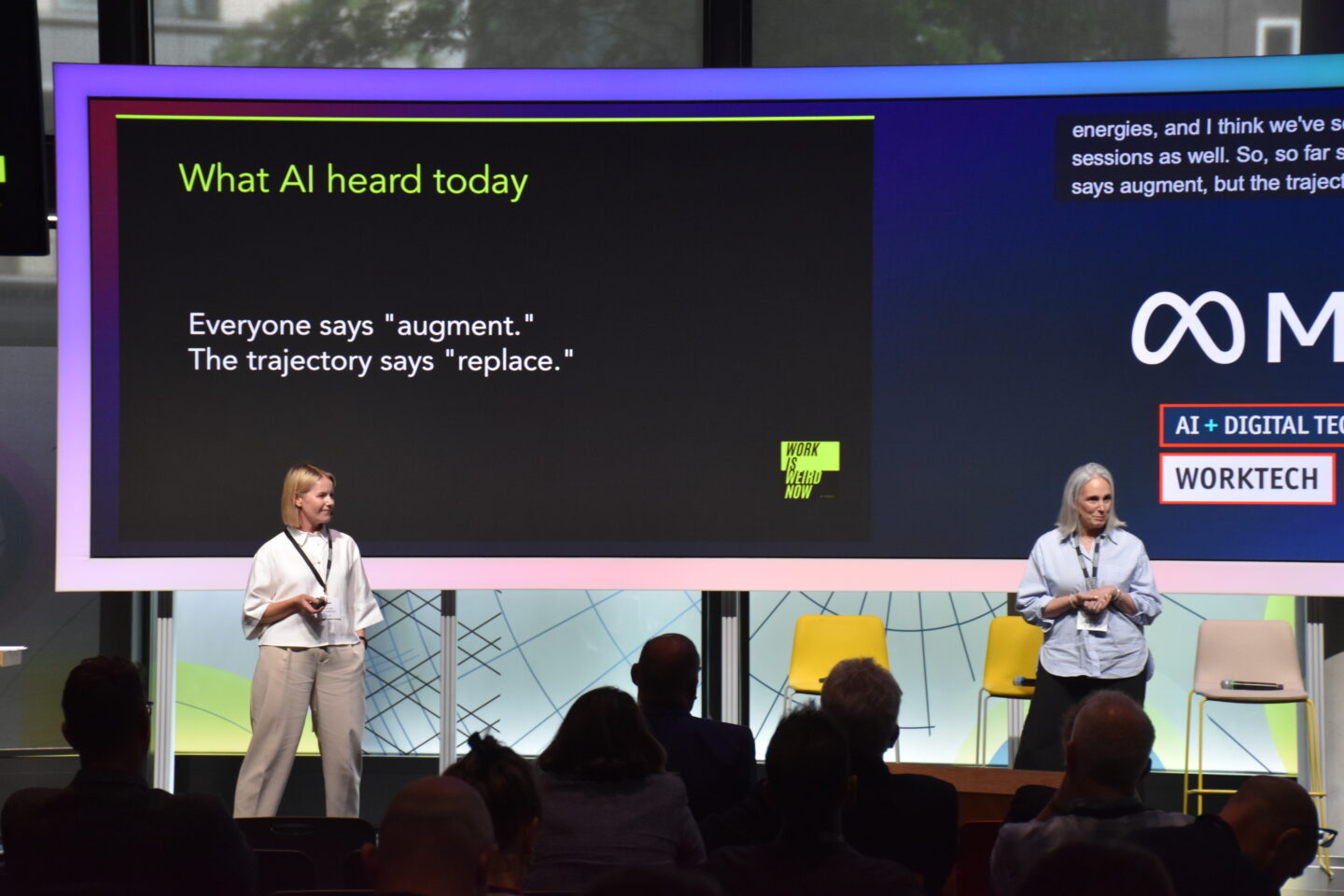
AI, unsurprisingly, ran through much of the day, but not in a simplistic way. Speakers were less interested in AI as a novelty than in how it changes the conditions of work. In facilities management, AI was presented as a practical tool for analysis, diagnostics and speed. In workplace technology, it appeared in everything from adaptive meeting environments and content systems to digital workplace platforms and automation layers. But perhaps the most interesting discussion came in the sessions on distributed tech companies and the AI era, where the question became less ‘what can AI do?’ and more ‘what does AI make the office for?’
One answer offered was that if AI increasingly supports heads-down individual work, then the physical workplace becomes more valuable as a site for strategic thinking, connection, culture and collaboration.
That idea was explored particularly well in the sessions on tech scale-ups and new workplace models. One speaker described the office not as a default place of work, but as a ‘commons’: a more intentional environment designed for strategic conversations, rituals, creativity and social cohesion, rather than routine solo tasks. Others echoed that view through discussions of hybrid culture, purposeful gathering and distributed teams. Again, the office was no longer being defended as a habit. It was being redefined as a place for the kinds of work and relationships that are harder to replicate elsewhere.
The Vancouver case study that best embodied this shift was ICBC’s move to The Hive. Beyond the headline real estate move itself, what stood out was the attempt to align building choice, design logic and organisational culture. The appeal of the new location was not just its sustainability credentials or reduced footprint, but its accessibility, flexibility and ability to support a more connected, visible and contemporary employee experience. Just as importantly, the project acknowledged that design must respond to real behaviours: natural light, flexible planning, collision points and shared spaces were all being used to encourage more meaningful interaction across a previously siloed organisation.
By the closing sessions, the conversation had shifted again, this time toward employee experience in its broadest sense. Here, the most compelling idea was that the workplace is moving beyond the ‘experience economy’ and into what one speaker called the ‘transformation economy’. In other words, the office should not only create enjoyable moments; it should help people grow. That means supporting confidence, learning, recognition, belonging and development, while also acknowledging that the best workplace cultures are not imposed by HR or design alone. They are created through leadership behaviours, thoughtful rituals, small everyday interactions and environments that make meaningful connections more likely.
Taken together, WORKTECH Vancouver felt less like a launch event and more like a statement of intent.
The strongest message of the day was that the future workplace will not be won through mandates, amenities or technology in isolation. It will be won by organisations that can connect human needs, spatial design, operational intelligence and digital capability into a coherent whole.
In Vancouver, that future was framed not as a choice between people and technology, or between office and hybrid, but as a more demanding challenge: to create workplaces that are intentional enough to matter, intelligent enough to adapt and human enough to be worth the journey.