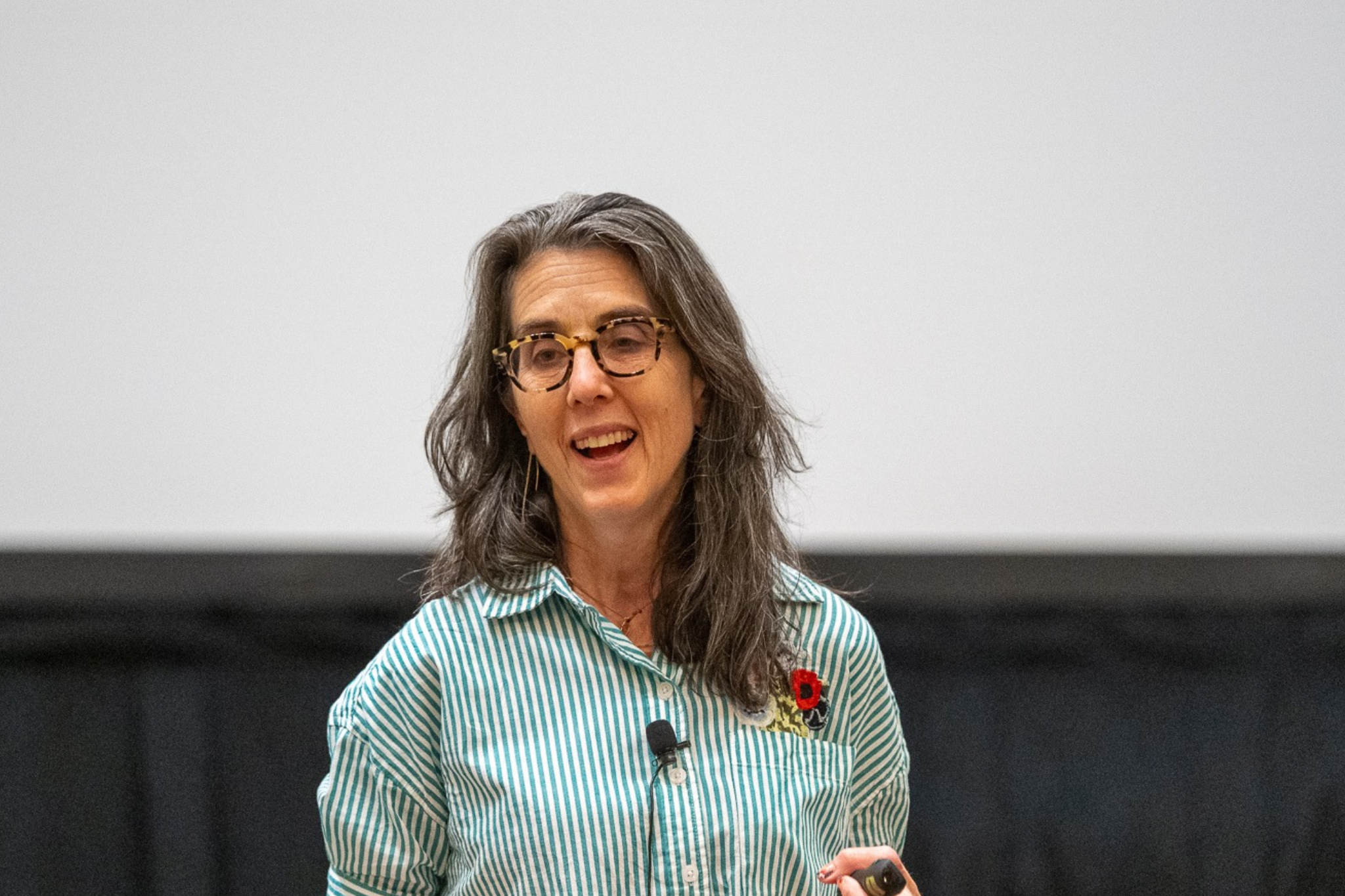
Ahead of her appearance at WORKTECH26 New York, BCG Managing Director and Senior Partner Deborah Lovich explains why leaders must take ownership of the everyday employee experience, how five simple habits can make work more human, and why enjoyment at work is a driver of performance rather than a trade-off.
Burnout is high, engagement initiatives often fail to endure, and AI is changing work faster than many organisations can redesign it. Deborah Lovich believes the answer is not another complex transformation programme. In her forthcoming book, Make Work Work, she sets out five repeatable practices that managers, executives and CEOs can weave into the working day: Celebrate Someone; Go, See, and Help; Be Interested; Cocreate; and Do It First.
Lovich will speak at WORKTECH26 New York on 8 October. In advance of the event, WORKTECH spoke to her about the thinking behind the book, the responsibility of leaders and the connection between more enjoyable work and stronger organisational performance.
This interview has been edited for length and clarity.
The case for making work work
Make Work Work arrives as burnout, disengagement and uncertainty about AI are reshaping working life. Why is this the right moment for the book?
I draw a parallel with customer experience in the 1990s. At that time, many organisations believed they could not afford to delight customers because their priority had to be productivity, profitability and shareholder value. Technology companies subsequently proved that customer delight was not a trade-off with value creation; it was a driver of it.
We are at a similar point with employees. Organisations often assume that making employees happy will mean higher salaries, more benefits, greater flexibility, fewer hours and faster career paths, all at the expense of performance. My research over almost four years shows that this is a false trade-off.
Creating work that people genuinely enjoy – the work they do every day, rather than peripheral perks – creates value for employees, customers and shareholders.
With AI adding further pressure and uncertainty, there has never been a more urgent moment to act.
You argue that much leadership advice on engagement and wellbeing does not solve the problem. Where does it most commonly fall short?
The biggest problem is that responsibility for employee wellbeing and engagement is handed to HR. Talented HR leaders can improve recruitment, onboarding, performance management and career development, and all of those experiences matter. But they sit at the periphery of the work people do every day.
Leaders would never ask the finance department to run their profit and loss account for them. In the same way, they should not ask HR to take sole responsibility for the daily employee experience. Leaders need to own outcomes for shareholders, customers and employees. That includes making the work itself enjoyable enough that, on balance, people can say they genuinely like what they do.
Why are daily managerial habits a more effective route to lasting cultural change than a complex programme or top-down mandate?
Study after study shows that the most important influence on whether employees enjoy their work is their interaction with their day-to-day manager.
People want to be seen, valued, supported, respected and invested in. They also want to have some fun. Exciting work can become miserable in a toxic team, while relatively routine work can become rewarding when people have a supportive manager and opportunities to learn and experiment.
Structural changes may still be necessary, but leaders can unlock a great deal within the organisation they already have. Think about the happiest and most motivated person on a team and the value that person creates. Then imagine the potential if everyone felt similarly motivated. The change required is behavioural. Like exercise, it works through small actions repeated consistently.
Five habits for everyday leadership
How did you arrive at the five practices in the book?
The first draft contained around 40 pieces of advice drawn from 35 years of experience. My publisher rightly said that no one would use a book that felt that overwhelming. He asked me to identify three to five actions that were practical and offered the greatest impact for the effort involved. I chose five.
Some of the original advice focused on what employees could do for themselves. But the evidence kept bringing me back to leaders: the manager, the manager’s manager, the executive team and the CEO. They have the greatest power to shape how work feels every day.
What do the five practices look like during a real working week?
Celebrate Someone means acting on positive thoughts. If someone makes a valuable contribution in a meeting, delivers a powerful presentation or draws useful learning from a project that did not succeed, tell them. Recognition should be specific and genuine, and it can be directed towards anyone, including someone more senior. The important point is to notice good work and acknowledge it every day, not once in a while.
Go, See, and Help draws on servant leadership. Leave your office, spend time where the work happens and look for something practical you can do to support the team. On an intensive consulting project, for example, I once collected everyone’s dinner order because the more junior team members had urgent work to complete. It was a small action, but it showed that hierarchy should not determine who helps whom.
Be Interested means getting to know people as people. Ask about them and remember what they have told you. If someone is more private or introverted, make it safe by sharing something about yourself first.
Cocreate means involving the employees affected by a project or initiative from the beginning. Organisations sometimes leave an empty chair in meetings to represent the customer. I would fill that chair with a frontline employee. The work will be better and people will feel part of creating the change rather than having it imposed upon them.
Do It First means never asking people to do something you are not visibly prepared to do yourself. If you want people to take an additional shift, take one. If you want them to reinvent their workflows with AI, begin by applying AI to your own work. Leadership example has to be observable.
Which of the five habits is most difficult for leaders to adopt consistently?
Cocreate is usually the hardest. Leaders worry about taking people away from their day-to-day responsibilities or believe they do not have time to involve them. Yet the quality and commitment created by genuine participation can outweigh that investment many times over.
Go, See, and Help can also feel structurally difficult, particularly when senior leaders work in a corporate office while frontline teams are distributed across different sites. But it is often easier than leaders assume. An executive team could, for example, hold its monthly meeting at a different operational location and spend time understanding the work there.
How can busy managers build these habits into existing routines without adding more meetings or administration?
The practices are designed to happen within work, not alongside it. Celebrating someone can take a few seconds after a meeting. Being interested can begin with remembering something a colleague previously shared. Going to see the work can replace a meeting held at a distance. Cocreating means changing who participates in an existing project, and Doing It First begins with the leader’s own behaviour.
It may feel unnatural at first, so I encourage leaders to put conscious effort into it for a week. The response is often immediate. But the action must be personal and sincere: generic recognition or a formulaic message can feel performative and have little value. Paying attention is the essential discipline.
Leading hybrid and AI-supported teams
What changes when a leader cannot rely on informal, everyday contact in the office?
The principles do not change. Even when people share a building, many teams are effectively distributed and do not encounter one another informally. These habits are a mindset expressed through everyday interactions, and they can be practised remotely as effectively as they can in person.
The important thing is to make them part of how the team works: noticing a contribution on a video call, checking in with someone deliberately, inviting employees into the design of a change, and making leadership behaviour visible across locations.
How can leaders ensure AI-supported workflows make work more effective and enjoyable rather than more fragmented or pressured?
Bring the employees who deliver the work and create the value into the design process. Do not develop a new workflow at a distance and then ask people to adopt it. Build it with them, while applying the other four practices as well.
The connection between employee experience and technology maturity is significant.
My research shows that employee-centric organisations are seven times as likely to be AI-mature.
Supporting employees is therefore not separate from successful AI adoption; it is one of its foundations.
What role does cocreation play when organisations are redesigning jobs, teams and workplaces around new technologies?
The difficult question is what happens when redesigning work may remove existing roles. Employees and leaders will need the ability to adapt, become comfortable with discomfort, relinquish established expertise and learn new skills. Some people will embrace that challenge more readily than others.
The sooner employees participate in creating a future they want to join, the better. AI will create new roles as well as change existing ones, and we are only at the beginning of that process. When employees enjoy their work and help shape the transformation, performance improves. That gives an organisation a stronger chance of growing with less additional hiring, rather than simply cutting jobs.
What does ‘Do It First’ look like when senior leaders are themselves under intense pressure?
It means being honest about the pressure, asking for help and creating a sense that everyone is in it together. Leaders do not need to pretend they have every answer. They need to become comfortable being uncomfortable – and publicly uncomfortable.
That openness is itself an act of leadership. It models the adaptability and learning that leaders increasingly expect from others, particularly as organisations experiment with AI and new ways of working.
From human benefit to business value
What evidence connects these everyday behaviours with stronger organisational performance and resilience?
Research I conducted as a BCG Institute fellow shows that employees who enjoy what they do each day are half as likely to be looking for another job. Retention matters in any labour market because organisations always need to keep their best people.
Those employees are also between two and four times more likely to bring their full motivation to work.
In research involving the 5,000-person US salesforce of a global company, employees who enjoyed their work sold 25 per cent more per hour than those who did not.
That is powerful evidence that making work more enjoyable is not simply a wellbeing initiative. It is a route to higher performance and value creation.
What is one habit a leader attending WORKTECH26 New York could begin practising immediately?
They do not need to wait until the following day. They can start that afternoon by Celebrating Someone and Being Interested.
Every leader can think back to the manager they valued most and the project on which they gave their all. What did that manager do? Much of this is obvious when we stop to consider our own experience, but the obvious is easily overlooked. The opportunity is right in front of us, and the acceleration of AI makes acting on it more important now than ever.